

With temperatures at an all-time high and the sun beaming, now's the time to remind you that floppy hats and sunglasses aren't the only things you need to put on before leaving the house. If sunscreen isn't the first step of your everyday morning routine, you could be leaving your skin vulnerable to burns and developing visible signs of early aging.
That's a risk I'm not willing to take, so I always make sure to apply SPF before leaving the house. As a commerce writer, I have access to a ton of formulas from a variety of brands, which can get overwhelming. If it feels that way for me, I can imagine trying to decide on the right sunscreen for the average consumer feels 10-times worse.
To help make the decision easier for you, I put nine of the most popular, top-rated and customer-loved options to the test for our Shop TODAY Ranked series, narrowing them down to my favorite picks based on several factors, from scent to formulation.
I also spoke to dermatologists to learn more about the dos, don'ts and must-haves of your everyday SPF.
 Best for pairing with makeup$19.78$28.00


What to look for in sunscreen
"For sunscreen, it has to be broad-spectrum," says board-certified dermatologist Dr. Dara Spearman. She explains that the SPF number you typically see on a sunscreen bottle refers to how long your skin can last before getting burned by UVB rays.
For example, an SPF 30 means you can stay out 30 times longer than you can without it, sans burning. "But you have to look for that effectiveness against UVA and it should say 'broad-spectrum.' That means it has both UVA and UVB [protection]," she clarifies.
According to board-certified dermatologist Dr. Azadeh Shirazi, a broad-spectrum formula can protect against skin aging and sunburn, but which ingredients actually give sunscreens their dual protection?
Shirazi says you should check the label for zinc oxide, titanium dioxide, avobenzone, mexoryl SX and Tinosorb. "Mineral UV filters like zinc oxide or titanium dioxide are ideal for sensitive skin or conditions like melasma, rosacea or acne," she adds. "Chemical filters, such as avobenzone or octocrylene, tend to feel lighter and blend in more easily."
And if you're looking for extra skin benefits, Shirazi says to look for formulas with antioxidants like vitamin E and green tea, as well as hyaluronic acid and glycerin for extra hydration.
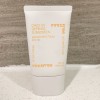
Best overall facial sunscreen


No white cast score: 5/5 | Long-lasting score: 4.75/5 | Makeup compatibility score: 5/5 | Scent score: 4.25/5 | Feel score: 5/5 | Application score: 5/5 | Overall average score: 4.83/5
It’s no secret that I love this K-beauty brand (the Vitamin C Exfoliating Toner Pads actually reminded me what blemish-free skin looks like), and I’m happy to report that its sunscreen is just as effective and game-changing.
The formula sinks into the skin effortlessly and requires hardly any dry-down time before starting your makeup routine. Plus, it offers a dewy base that gives the skin a glow even with a little foundation and concealer on top. There’s also zero pilling or product breakup, even in spots that crease like around the nose and smile lines.
The only thing I want to note is the scent. The formula features sunflower seed oil, cica and green tea, and I think it’s the last of the three that sticks out the most the moment when I give it a whiff. It’s by no means a deal breaker for me, but I can see it bothering anyone sensitive to fragrance.

More facial sunscreens, as tested by the author
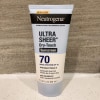
Best for pairing with makeup:


No white cast score: 5/5 | Long-lasting score: 4.75/5 | Makeup compatibility score: 5/5 | Scent score: 4.75/5 | Feel score: 3.5/5 | Application score: 5/5 | Overall average score: 4.67/5
I happened to try this formula on a recent trip to Arizona, where temperatures reached a high of 106 degrees Fahrenheit (and, reportedly, a “feels-like” temperature of 112 degrees). I knew if this sunscreen didn’t cooperate with my makeup products, or didn’t work well with my naturally oily skin, this could be a bad beauty day. In actuality, I looked like a glowing goddess. My creams didn’t move, my foundation didn’t disappear — this sunscreen didn’t mess with any of it.
And despite the intense sun and heat, I didn’t burn! To say I was impressed is an understatement. However, it definitely took its sweet time to fully sink into the skin, so your face is going to feel a little slippery. I suggest giving it a few minutes or hitting your face with a fan before continuing with makeup.
In terms of staying power, this formula did its job. Using my UV light tool, I saw that it protected my skin for a little over two hours. I would follow through with its directions to reapply after that amount of time, because it was starting to fade within 15-20 minutes after that two-hour mark.
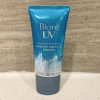
Best long-lasting formula:


No white cast score: 5/5 | Long-lasting score: 5/5 | Makeup compatibility score: 4.5/5 | Scent score: 5/5 | Feel score: 3.5/5 | Application score: 4.5/5 | Overall average score: 4.59/5
This is a true trust-the-process formula. At first, the gel is going to feel incredibly greasy on your fingers and face. I had almost written it completely off the moment I touched it. However, that feeling goes away once the product sinks into your skin (which happened far more quickly than expected, thank goodness).
If I could give it a standing ovation for anything, it would be just how long this lasted on the skin. Using my UV detector, I could still see remnants of the cream well beyond the four-hour mark, which is something none of the other brands came close to doing.
Plus, we love an unscented sunscreen. You have to really stick your nose up to the gel for any chance to catch the slightest SPF smell.
Easiest application:


No white cast score: 5/5 | Long-lasting score: 4.25/5 | Makeup compatibility score: 4.5/5 | Scent score: 3.75/5 | Feel score: 5/5 | Application score: 4.5/5 | Overall average score: 4.5/5
I'm pleasantly surprised by this sunscreen's feel. It has a thicker consistency than other formulas but it doesn't leave feel heavy on my skin. It also sinks in quickly, so I don't need to wait long for it to dry down before adding makeup. I found that my complexion products worked well with EltaMD's formula — never creasing or cracking — and even lasted a pretty long time on the face.
I'm knocking off a few points because the formula tends to get stuck in the pump when trying to apply it. That definitely makes it harder to get a precise amount. However, I'm a big fan of a pump in general and wish other brands would follow suit as it's easier to control formula flow.
Best scent (or lack of!):


No white cast score: 5/5 | Long-lasting score: 3/5 | Makeup compatibility score: 4.25/5 | Scent score: 5/5 | Feel score: 4.5/5 | Application score: 4.75/5 | Overall average score: 4.42/5
I won't lie; I was expecting to thoroughly dislike this one. Having always thought of Glossier as primarily a makeup brand, this is the first skin care product from them that I've tried. At first, the slippery consistency gave me pause. However, unlike other goes-on-clear sunscreen formulas, this one didn't feel like an uncomfortable oily layer on top of my face. It melted into my skin rather quickly, but instead of feeling greasy, it left my face feeling incredibly soft and smooth.
The best part is the scent — as in it doesn't have one! If you're sensitive to any kind of fragrance or just can't stand the smell of traditional sunscreens, this is your winner right here. The only thing that I have a problem with is that my UV device showed the formula rapidly fading before the two-hour mark, possibly even before 1.5 hours.
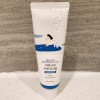
Most hydrating:


No white cast score: 5/5 | Long-lasting score: 4.75/5 | Makeup compatibility score: 4/5 | Scent score: 4/5 | Feel score: 4/5 | Application score: 4.75/5 | Overall average score: 4.42/5
This formula’s texture is really nice. It glides on, feeling a little slick at first; however, it dries down incredibly smooth. My only note is that I wish that dry-down process happened a lot faster, since I’m not a big fan of that greasy feel (but really, who is?).
With how soft my skin felt post-application, I believe the brand when it says its product is packed with hydrating ingredients — vitamin E and Australian hibiscus being the most notable.
Unfortunately, there’s no getting away from that well-known sunscreen smell with this one. However, it doesn’t linger. I don’t mind it since that smell hits rather nostalgic, reminding me of family trips to Long Beach Island during my childhood.
Best budget sunscreen:


No white cast score: 5/5 | Long-lasting score: 4/5 | Makeup compatibility score: 4.5/5 | Scent score: 3.25/5 | Feel score: 4.75/5 | Application score: 4.5/5 | Overall average score: 4.33/5
This formula really impressed me, especially for one that costs less than $9. It feels a little heavy when you squeeze it onto your fingers, but is actually pretty lightweight on the face. You need to give it a good rub to ensure it absorbs, but the white cream disappears after a few seconds. It glides on easily and actually makes my face feel super smooth. Plus, my makeup seems to really gel with the formula.
What I can’t get over is the scent, which smells like a cross between diaper cream and cheap public bathroom soap. Luckily, I don’t detect it after applying to the face, but I hope anyone who gets close to me doesn’t get a whiff of it.
Most lightweight formula:


No white cast score: 5/5 | Long-lasting score: 3/5 | Makeup compatibility score: 4.5/5 | Scent score: 4.25/5 | Feel score: 5/5 | Application score: 3.5/5 | Overall average score: 4.21/5
This texture of this sunscreen feels really nice on the skin. That might have to do with the fact that it's supposed to double as a primer, so it has the smooth consistency that you typically feel with that kind of product. It follows through with its promise of feeling weightless throughout its wear time, and it didn't have a negative effect on my acne-prone skin.
I'm not the biggest fan of this tube's applicator. I use the three-finger rule to ensure I'm applying enough product, but the opening of this packaging dispenses a little too much at one time if you squeeze with too much pressure.
How I tested each sunscreen
Each sunscreen was thoroughly tested on both clean skin and under makeup for multiple weeks. During this period, I rated each formula and chose my favorites based on several factors:
- No white cast: Was the formula difficult to rub in completely? Did it disappear?
- Long-lasting: How long did I feel comfortable before re-applying?
- Makeup compatibility: Did the formula pair well with my makeup products? Was there any pilling or breakup of product?
- Scent: Is there fragrance added, and if so, is it overbearing? Is there even a scent at all?
- Feel: Does the formula feel comfortable on the skin when first applied? Is it soft? Soothing? Does it irritate sensitive or acne-prone skin?
- Application: Does this apply easily? Does it offer a pump or tube that needs to be squeeze? Is it messy?
In order to test longevity, I utilized a UV camera to try and determine how long each formula lasted on the skin and get a better idea of what coverage actually looked like.

Why trust Shop TODAY
Danielle Murphy is the audience development writer for Shop TODAY. She joined the team in 2021 and has covered everything from beauty trends to the hottest sales to shop. A New Jersey shore native and current resident, Murphy finds herself at the beach more frequently than she would prefer, making her the perfect candidate to test your favorite sunscreens. She is also no stranger to the testing process when it comes to finding the best products, having previously written about bath towels and kitchen sponges for Shop TODAY's Ranked series.
Meet the expert
- Dr. Azadeh Shirazi, MD, is a board-certified dermatologist specializing in medical, surgical and cosmetic dermatology at La Jolla Laser Derm in California.
- Dr. Dara Spearman, MD, FAAD, is a board-certified dermatologist based in Fort Wayne, Indiana.

